At 23 Weeks, She Went Into Labor After ICE Detained Her Husband, An Update On The Family
By Erik Sandoval, Executive Producer NVN | January 29, 2026
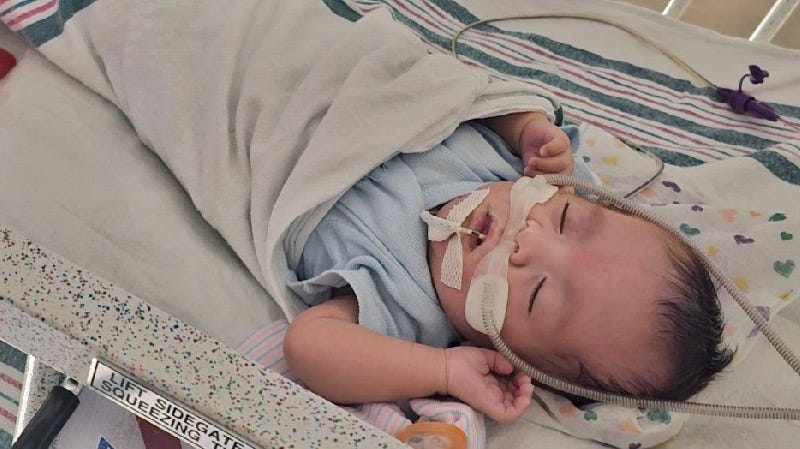
JACKSONVILLE, FLORIDA— Josselyne and Pablo’s son was born at 23 weeks. Only one pound. Small enough to fit in your hand. Over the past 19 weeks he has grown but is still hospital bound, not yet fully able to breathe unassisted. His mother gave birth prematurely, she says, in part due to stress after her husband was detained by immigration officers.
Two-and-a-Half Months in Detention
Pablo didn’t learn of his son’s birth until nearly 20 days later when he was finally able to call Joselyne from inside a detention center.
“When I arrived I was eager to speak with my wife to let her know where I was , so I kept asking the guards ‘How do I make a phone call?’ And they’d never give a straight answer. They’d say, ‘Someone will come explain it later,’ but no one ever did.”
Pablo was able to figure out how to make a call using his A-Number—an individual number designated to undocumented immigrants within the immigration detention system.
“I got one free call for 30 seconds,” Pablo said, “which was the only time I was able to explain the system to my wife, from then on she made deposits into my commissary account.”
Josselyne says she deposited an average of $20 every day into an online account which would get her a 15-minute phone call. Some days the money would disappear if it wasn't used.
“I was never allowed video calls, only phone calls,” Pablo said. “So I couldn’t see my son.”
Josselyne once tried to send a few pictures of the baby. “I don’t know what happened,” she says. “He never got them.”
Inhumane Treatment
Inside the Baker Correctional Institution in Sanderson, Florida, Pablo was housed in a room he guesses was designed to fit 100 people, but had 200 people packed inside, he said.
“The lights were on 24/7. The air conditioning was blasting at the maximum cold 24/7,” he said.
Despite the cold, detainees were each given only one mylar foil blanket.
Bed bugs were a constant problem.
“We’d all get bites. Some nights you couldn't even sleep because those insects would bite so hard.”
“We’d sleep on cots so narrow that if you rolled over you would fall right out. And they were bunks. One night a man rolled out of the top bunk and fell to the ground and split open his head. The guards didn’t do anything. They didn’t bring him medicine. Nothing. They didn’t take him to the medic. Nothing.”
Whenever detainees were moved between rooms they would all be shackled single-file to one chain by the ankles, waist, and wrists.
“There were elderly people there who couldn't walk and they were shackled the same as the rest of us. It was horrible treatment. Totally inhumane.”
Over the course of his detention, Pablo said he lost nearly 50 pounds.
“I went in weighing 208 lbs and came out 160 lbs.”
Good People in Bad Places
Pablo says not all the guards were inhumane.
“There were lots of Black and Latino guards,” he said, “Among them they would talk, they would whisper, and I’d pretend like I didn't understand English so I could listen in on their conversations.”
“I heard two guards talk about how they had been lied to by the company. They were told they were going to be guarding regular criminals, they didn’t know it would be immigrants. And so they accepted, signed contracts, but in the end they felt misled because it wasn’t regular criminals in there, it was us. And so I guess they quit. I don't know. I didn't see them again.”
But while some lower-level employees inside the detention center may have been sympathetic to the detainees, the facility’s leadership took a much harder approach.
“Once we were given some playing cards, some dominoes, by one of the guards,” Pablo said. “But then when their supervisor found out, apparently he didn’t approve. So as punishment they put us all into this other room without water, without bathrooms, for 24 hours. Totally inhumane.”
Exiled on Both Sides
Without warning Pablo was transferred out of the Baker Correctional Institute.
“When they moved me, I lost all that money that was in that commissary account. Some $300, $400 . It didn't transfer over. They just kept it.”
He was sent to ERO Camp East Montana in El Paso, Texas, where for three days he was given only an apple, juice, and water, three times a day.
“I was worried he would get sent back to Nicaragua,” Josselyne told me. “So I kept calling the Mexican consulate in Orlando insisting they take his case because he had Mexican residency.”
Pablo and Josselyne were both part of Nicaragua’s recent pro-democracy movement and fled the country for fear of political repercussions - now Pablo faced being sent back.
“I'm a political exile. I'm a “Blue-and-White’ against the government of Nicaragua. I couldn’t go back there,” explained Pablo. “I’m labelled a traitor out there. There is a price on my head in Nicaragua.”
Josselyne’s persistence paid off and with the help of the Mexican Consulate her husband’s case was fast-tracked - he would get out of detention, but he would be deported to Mexico.
“The authorities took everything when he was arrested,” says Josselyne, “But when they dropped him off in Mexico they didn’t give any of it back. Not his passport. Not his ID. Nothing.”
Starting Over
“They woke us up at about 3 in the morning," says Pablo. “There were about 70 of us. They loaded us into a bus, took us to the border and dropped us off. ‘Go on,’ they said. ‘Cross.’ Some of the people there didn’t want to cross, but they pushed them and even hit a few to make them cross.”
Pablo says after about two hours Mexican military personnel arrived with an immigration bus. “The treatment the Mexican authorities gave us was dignified, humane, lovely compared to how I was treated in the USA. They offered us water immediately. We hadn't drank anything in hours. They gave us snacks, refreshments. I remember I ate three burritos they gave me.”
“I went through lots of bad things in Nicaragua, even torture,” says Pablo, “But many of the abuses I suffered in the US aren’t any different than what I went through in Nicaragua.”
Josselyne meanwhile had taken part-time work at a gas station to make ends meet. But the needs of her child became too great and now she is back in the hospital full-time, caring for her son.
“The nurses here are good but they can't be holding him all the time,” she says. “They told me I need to be here. So here I am. Twenty-four hours a day. Seven days a week.”
While she is eager for her son to get strong enough to leave the hospital, she worries about the future. “Once we are out of the hospital we are on our own.”
Despite the hardships of being in different countries, the family is closer than before.
“Now he can call whenever,” says Josselyne. “We can talk any time. He used to talk to my stomach, so my son knows his voice. Now he can video call. He can see his son anytime he wants. It wasn’t like that when he was in the detention center.”
“Even though we are separated,” says Pablo, “we are more united than ever.”
“Hope is the last thing you lose,” Pablo reminds me. “I hope I’ll be with my wife and baby someday. I don't know if that will happen in Mexico, US, China, Japan, but I hope it happens. I know it will.”
Read the previous article here.
Josselyne has established a GoFundMe to help the family get on their feet after leaving the hospital: https://gofund.me/ea8469a41


This story is despicable, but -- unfortunately -- not uncommon. The Trump administration wants to say immigrants are on welfare and taking all of our financial resources. But, in every case I have read, the detainee was taken from a job where s/he worked full time. So, now that the bread winner in the family has been taken away by the U.S. government, of course the dependents have been forced into a situation where they require some kind of financial relief. Trump and his cohorts are hypocrites. How can you prevent people from being able to pay their way in this country and then crucify them for needing assistance?
I just do not know how this is the worst of the worst. Story after story.....just heart breaking. I do
not know how people can think this
Cruelty is ok ? It is not...and I pray that Miller and all those involved in
this horror soon see the light of day through a prison cell.