Dilley: Where Families Die Slowly, Together
By Nick Valencia | March 4, 2026
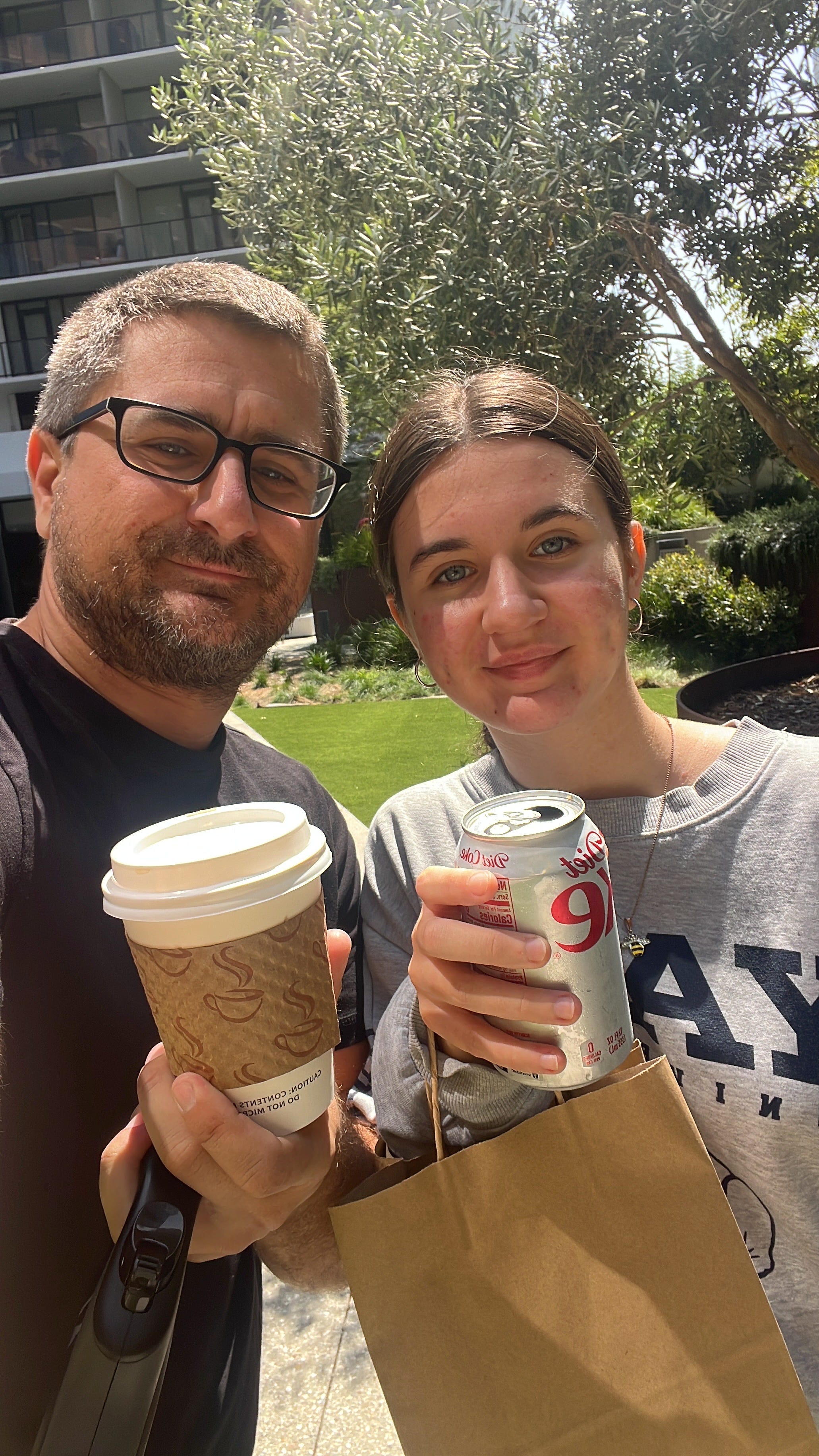
DILLEY, TEXAS— This week, Alexandra was walking her dog with her father when she saw the white van again.
To anyone else, it would have been forgettable.
To Alexandra, it looked exactly like the van that had transported her into federal custody.
Weeks earlier, the 14-year-old middle school student and her father were released after spending more than a month inside immigration detention.
During that time, she and her father saw things they wish they never did. They say overlapping illness's spread through the complex, including flu-like and norovirus outbreaks. Children were sick, regularly vomiting in shared spaces without care. Medical treatment was minimal. Fresh food was scarce. “School” lasted about an hour a day. Anxiety and poor mental health was often met with little more than stickers.
For Alexandra, the experience left something behind: the feeling that, for the first time in her life, she had no control over what would happen next.
So when she saw the white van again this week, she froze.
“We brought you Christmas presents”
Between December 26 and January 27, Alexandra and her father lived inside the South Texas Family Residential Center in Dilley. It’s one of the largest immigration detention facilities for families in the United States. It’s also currently the most controversial after gaining attention for a series of traumatic stories.
This is the same facility where haunting footage filmed from a drone showed detainees in colorful prison like garbs, staring back blank faced and emotionless. It looks so horrific people thought it was AI. The paradox was not only visually arresting. It was symbolic. Dilley is also the same facility where 5-year-old Liam Conejo Ramos was taken after being used as bait in Minneapolis to try to lure out his relatives from inside the family home. The image of him in his tiny blue beanie and Spider-Man backpack galvanized parts of the country that previously had not shown much interest in the story.
On Christmas Day, 2025, Alexandra and her father became part of the story.
The Man In The Santa Hat
Max is a truck driver. He took his daughter along with him during his road trips while she was on winter break for middle school school. They pulled over at a truck stop in Phoenix, Arizona, when they both saw a man wearing a Santa hat step out from behind a truck stop.
“Sir,” the man called out.
Max remembers turning around and seeing the badge.
Within seconds, he said, he and Alexandra were surrounded “by 10, maybe 15 different agents,” and taken into custody.
When they arrived at the detention facility in Phoenix, Max says officers greeted others inside with a joke.
“Hey, we brought you some Christmas presents.”
The presents were Max and his daughter.
Max and Alexandra spent their first night there, in a room that was freezing. They were kept together the whole time. When asked if he had any safety concerns for his minor age daughter, Max said no.
From their perspective, those around them at the Phoenix detention center were others who had been detained during what appeared to have been a sweep at the truck-stop where they were arrested. The only other individual in their cell with them was a truck driver whom Max said that he knew.
The worst part was the cold.
“I think it was something like 56 or 58 degrees.”
They were given blankets but no beds, only thin mats on the floor. For Alexandra, the shock wasn’t just the cold. It was seeing her father handcuffed.
Parents are supposed to control the world around their children. Inside detention, that order was reversed.
“I was panicking,” she said. “We didn’t know what was going to happen to us.”
The next day they were placed on a commercial flight to San Antonio, escorted by staff who monitored them constantly like chaperones, even during trips to the restroom.
Once they arrived at the South Texas Family Residential Center, every day the next month would be a nightmare.
“Kids Vomiting Everywhere”
The South Texas Family Residential Center in Dilley was designed to hold families awaiting immigration proceedings. It is not a secret prison and it is not hidden from public view. But accounts from families who have passed through its gates describe an environment built for confinement rather than care.
Better known as “Dilley,” is intentionally built for detained families.
Inside, Max and Alexandra described a layout that mimics a pre-K classroom. Pictures of animals are used as labels so that children can easily distinguish where they belong.
Housing areas are labeled with things like Green Frogs, Yellow Turtles, Brown Bears, Red Birds, and Blue Butterflies. Each area is designated for a specific group of the population, according to Max and Alexandra.
“The pregnant women were put in the Blue Butterflies,” Alexandra said.
Max and Alexandra were placed in the Green Turtles section. It’s this area where single adults and their minor children are housed.
Inside the facility, officials make an effort to keep families housed in the same area while maintaining some level of privacy for older children.
According to Max, the arrangements depend largely on age and gender.
If a father and daughter are detained together, they remain in the same housing section, but are typically placed in separate rooms. The same applies to a single mother detained with a teenage son. The policy, Max said, appears designed to keep families close while still providing privacy for older minors.
“The room itself, was manageable. There are bunk beds, there is a TV, there is a sofa,”
Max said.
Everything else, he said, felt suffocating.
During the month they spent inside, Max described “overlapping outbreaks.” He says sickness spread widely through the detention center. By their estimate, they were at least three “epidemics.” They described scenes throughout the detention facility of men, women, and children as young as toddlers regularly vomiting—some of them violently while the officials at the site did nothing.
“There was a flu-like epidemic,” he said. “Everyone was sick.”
At times, he said, children were visibly sick in shared areas.
“You see toddlers and teenagers vomiting all around the territory,” he said. “And no one is doing practically anything.”
According to Max, detainees who were ill were rarely separated from others. The typical medical response was simple.
“They say drink more water, take Advil, and if you don’t feel better in three days, come back.”
Max is not a casual observer. He told me he graduated from the Russian State Medical University. He described the medical staff inside Dilley as mostly nurses — not doctors — and said he believed they lacked the qualifications to diagnose illness.
Max says both he and Alexandra became sick during their detention. But one case still stands out to him.
A teenage boy began complaining about severe stomach pain.
“He had appendicitis,” Max said.
According to Max, the boy was initially told to return later if the pain continued. The teenager eventually collapsed.
“The only thing that saved his life was that he collapsed in front of the medical staff,” Max said.
Only then was he taken to a hospital for surgery.
Bad Food, No Nutrition, No Real Help
Meals followed a rigid routine.
Breakfast was boiled eggs and hash browns. Lunch and dinner were rice with chicken or beef.
Always rice.
Fresh fruits and vegetables were rare.
“They didn’t receive a single fresh vegetable or fruit,” Max said. “Only canned fruit.”
“The main issue is that the kids are there,” Max said. “They’re not getting enough nourishment… not medical wise, not in terms of the food… not in terms of psychology.”
Mental health support for children appeared minimal. Max says psychologists occasionally checked in.
“They ask if your kid is sleeping,” he said. “If they’re eating.”
“They asked us if we had thoughts of killing ourselves…,” Alexandra said.
“Yes, they asked about whether or not you had thoughts of harming yourself, but there was never any follow up,” he added
“They just give kids, like, some stickers,” he said. “And yeah, that’s all the treatment.”
Education was similarly limited.
Max doesn’t dispute that the facility has a building labeled “school.” He disputes what happens inside it.
“There is a school building,” he said. “But it’s only one hour a day. Kids are at their own disposal… only one supervisor… who also speaks mostly Spanish,” he said.
Alexandra didn’t attend.
“I didn’t really see a point,” she said.
“A simple conversation with their parents would be much more effective… than spending an hour there doing nothing,” he said.
Even the library was stocked mostly with Spanish-language books, limiting for non-Spanish-speaking families.
Cut Off From The Outside
Internet access was heavily restricted. Computers were essentially limited to email. And Max described a system that, in his telling, was designed to control information.
“They’re just not allowing to get us any information from outside and not allowing to bring the information outside of the facility,” he said.
Max said he accessed his daughter’s school portal using his parent credentials and sent messages to her teachers explaining they were in custody. That, he believes, is how the school system learned what had happened.
After that, he said, access was blocked.
Then came release — or the illusion of release.
Families inside the detention center rarely know how long they will remain there.
After spending nearly a month at that point in detention, on January 22, officials told them they would be released. They signed paperwork and packed their belongings.
Then nothing happened.
“We were ready to go… they told us that they will release us before 3 p.m.,” Max said. “We’ve been waiting… and by that time, we realized there’s nothing happening.”
They tried to ask why. He said no one explained. He said they waited for a week, living inside the emotional vertigo of almost-freedom.
“We’ve been doing it for a week, and no one was telling us anything,” he said.
Max believes that uncertainty is not an accident, that it is part of the pressure.
“We all had the feeling there that what they trying to do is… make us give up, to ask for self-deportation,” he said.
“Some people did give up and some people did leave,” he said.
One family he met had been there nine months.
Finally, on January 27, they were released.
Learning to Feel Safe Again
Max and Alexandra spent just over a month in custody—longer than the 21-day limit for detaining minors established under the Flores settlement. It may have had something to do why they were let go, but he said frankly, he doesn’t really know why he was released.
“We were lucky,” he said.
Even so, their release came with confusion. Especially for 14-year-old Alexandra. She went back to school as the most popular student, but not for the reasons one would hope.
“Everybody was aware of what happened to me,” she said. “Everybody was really happy… really supportive… the students, the teachers.
And in the week since her release, she has attempted to live a normal middle school life.
But some moments still follow her.
Like when she was walking her dog recently and the white van drove past.
“She was really uncomfortable,” Max said.
Inside detention, Alexandra had told her father something she had never felt before.
“For the first time,” she said, “we didn’t have control over the situation.”
Weeks later, the feeling still hadn’t completely disappeared.
Who knows if it ever will.


These bastards will pay the price for this cruelty. Karma is coming for them, hard and fast.