The Klan Already Knew. Why Trump's DOJ Needs A History Lesson
The Trump administration won the headline war on the SPLC indictment. A 1981 Klan newsletter proves why the central charge doesn’t hold.
By Nick Valencia | April 22, 20226
ATLANTA— On Tuesday, President Trump’s Department of Justice indicted the Southern Poverty Law Center for secretly running informants inside white supremacist groups. There is one problem with that. It wasn’t a secret.
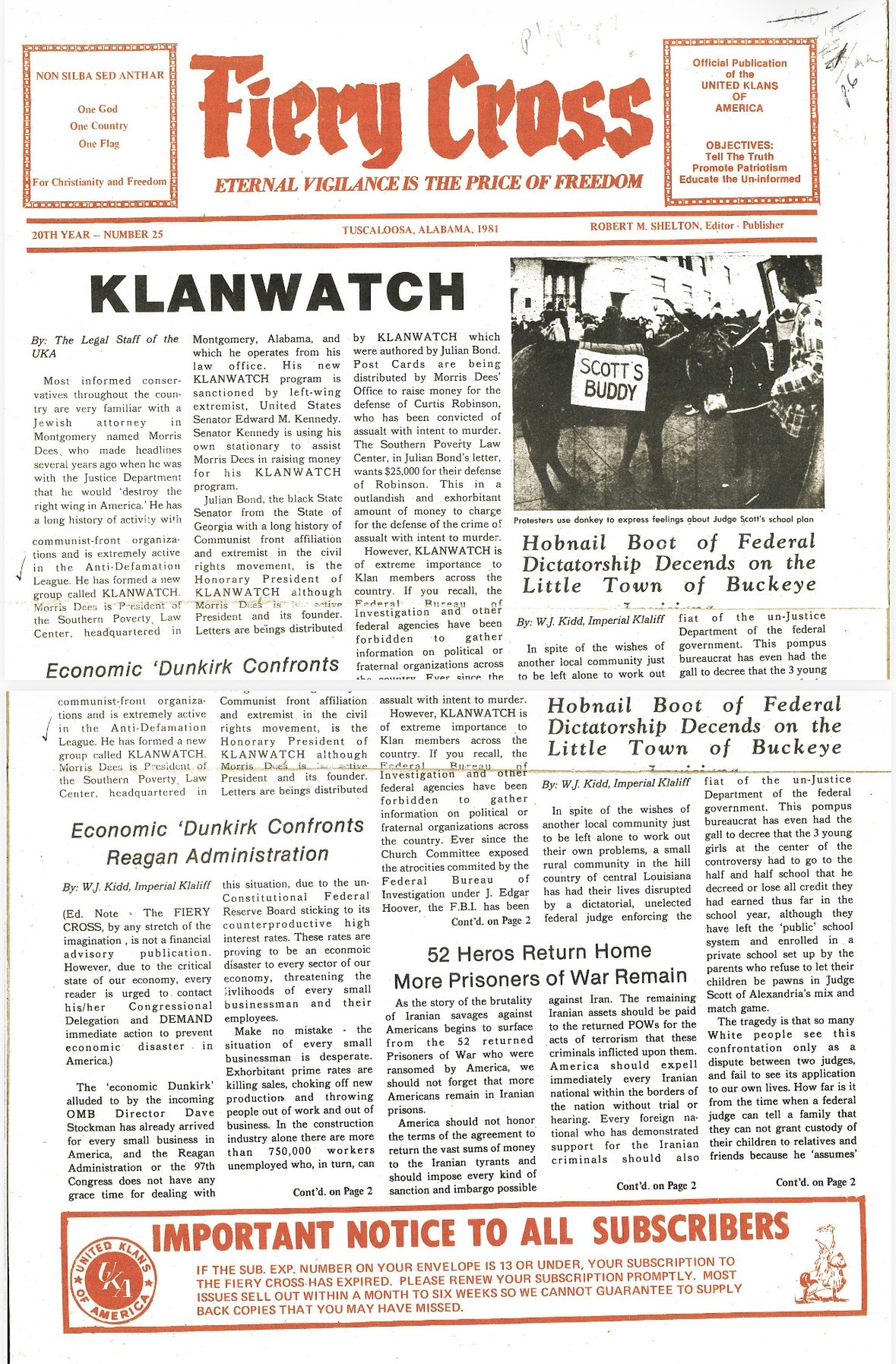
The Klan has been warning its members about it for decades. It said as much as far back as 1981, when the KKK published a warning to its members that the SPLC had placed people inside their ranks “for the purpose of gathering information.”
So when, Acting Attorney General Todd Blanche stood before cameras and announced an 11-count federal indictment against the Southern Poverty Law Center, accusing the organization of secretly defrauding donors by running a covert paid-informant program inside white supremacist groups, he must not have done his reading.
Strip away the press conference theater and here is what the indictment actually charges.
Between 2014 and 2023, the SPLC paid more than $3 million to informants embedded within white supremacist organizations, like the Ku Klux Klan, the Aryan Nations, the National Alliance, and others. To protect informant identities, the organization set up bank accounts under fictitious company names. The DOJ alleges wire fraud, bank fraud, and money laundering, because donors were not explicitly told the program existed.
And here is where Blanche’s own indictment turns against him.
Standing at that podium, he claimed the SPLC “was not dismantling these groups” but instead “manufacturing the extremism it purports to oppose.”
The Fiery Cross from 1981 renders that claim incoherent.
Edited and published by Imperial Wizard Robert M. Shelton, the Fiery Cross was operated out of Tuscaloosa, Alabama, as the “Official Publication of the United Klans of America.”
In 1981, the paper ran the front-page headline: KLANWATCH, “to warn Klanspeople and our supporters about the purpose of KLANWATCH and the dangers it involves.”
This wasn’t a secret, like acting AG Blanche alleged on Tuesday. This program has been openly talked about for decades.
The KKK’s verdict on the program was that it was “extremely dangerous to American freedom in general.”
Organizations that are not being dismantled do not dedicate their front page to warning members that they are being infiltrated. The Klan was not manufacturing alarm — they were expressing it, in print, under the signature of their own lawyers.
Read that again.
In 1981, the Klan’s own legal staff was so rattled by the SPLC’s informant program that they dedicated their front page to warning members about it. They weren’t confused about what Klanwatch was doing.
That is not what an undetected covert operation looks like. That is what a working one looks like.
The Math Doesn't Add Up
The central word in the government’s case is secretly. The load-bearing wall of the entire legal theory. And the Klan blew it down in 1981.
The Fiery Cross was not an internal memo. It was a publication with a subscription form, bulk rates, and a national mailing list.
John E. Mays, the Klan attorney whose byline appears in the publication’s contributor acknowledgments, was listed as practicing law in Decatur, Alabama. He was not operating in the shadows, but functioning as a public legal officer of the organization, warning members through a widely distributed newsletter that the SPLC had people inside their ranks.
The donors Blanche claims were defrauded? They existed in a world where the Klan’s own lawyers were sounding the alarm about this exact program in a publication available by subscription for six dollars a year.
An Imperfect Institution
The SPLC is not without its complications, and the reporting record makes that plain.
In 2019, my CNN reporting documented what employees inside the organization described as a “systemic culture of racism and sexism.” Fearing retaliation, then-staffers spoke on background about how an organization built on fighting racial injustice was credibly accused of perpetuating it internally.
The gap between the SPLC’s public mission and its internal conduct deserves continued scrutiny. But legitimate institutional failure and federal criminal fraud are two entirely different categories.
What Blanche announced Tuesday does not survive contact with the historical record—a record that includes the Klan’s own contemporaneous acknowledgment of the program’s existence and effectiveness.
A source based in Alabama with direct knowledge of the SPLC’s internal workings, spoke to Nick Valencia News on background, and was direct.
“It’s ridiculous on its face,” the source said of the indictment. “Infiltrating and undermining extremist groups is a very effective way of dismantling them.”
The political architecture of this indictment is not subtle.
The investigation was reportedly opened, then shut down during the Biden administration, then revived under Trump. The charges were filed in Montgomery, Alabama — the SPLC’s home turf. FBI Director Kash Patel, who severed the bureau’s relationship with the SPLC last year while publicly branding it a “partisan smear machine,” stood at Blanche’s side for the announcement. The SPLC has been among the most consistent institutional critics of this administration’s immigration policy, its racial rhetoric, and its approach to civil rights enforcement.
The pattern is established.
Organizations that have opposed this administration find themselves targeted by a Justice Department whose acting attorney general has publicly stated the president is “closely involved” in its operations.
What About Charlottesville?
There is one allegation in the indictment that demands serious examination and cannot be dismissed. Prosecutors allege that one SPLC informant was part of the leadership group that planned the 2017 Unite the Right rally in Charlottesville. The event turned deadly when Heather Heyer was killed after a white supremacist drove his car into a crowd of counter-protesters. The indictment claims the informant helped coordinate transportation to the event.
If accurate, that is a profound moral and operational failure.
What did the SPLC know, and when? What was shared with law enforcement before the rally? Why was that informant still active if their activities extended to facilitating logistics for an event that ended in murder?
A serious investigation would be demanding those answers.
What was announced Tuesday was a fraud case resting on the claim that donors had no knowledge of a program the Klan’s own lawyers were warning their members about in a nationally distributed newsletter in 1981.
This administration has mastered a specific form of political warfare: the headline is the punishment.
A federal indictment announced live, amplified in seconds, stripped of context before it reaches most people—does maximum damage regardless of what happens in court. The trial may never come. An acquittal, if it comes, will be a footnote. The damage is done the moment Blanche steps to the microphone.
The Fiery Cross ran its Klanwatch warning under the motto printed across the top of every issue: “Eternal Vigilance Is The Price of Freedom.” 45 years later, Todd Blanche is counting on no one still being vigilant enough to read it.
Nick Valencia is an independent journalist and founder of Nick Valencia News. He spent nearly 20 years as a CNN correspondent covering race, immigration, and justice across the United States and Latin America. He is a graduate of USC’s Annenberg School of Journalism and a proud son of Eagle Rock, Los Angeles.