


In Social Circle, Georgia, local leaders say they learned from the press that the federal government wanted to build one of the largest detention centers in the country. Overnight, they did the only thing they felt they could: they shut off the water.
By Nick Valencia | March 17, 2026
SOCIAL CIRCLE, GEORGIA— This is the kind of place Republican politicians love to romanticize. Social Circle, Georgia: small-town America, working people, conservative values. The sort of place the GOP invokes when they talk about law, order, sovereignty, and the forgotten American community.
Now that same community is being told it may become home to one of the largest ICE detention facilities in the country. And suddenly the abstraction has become local.
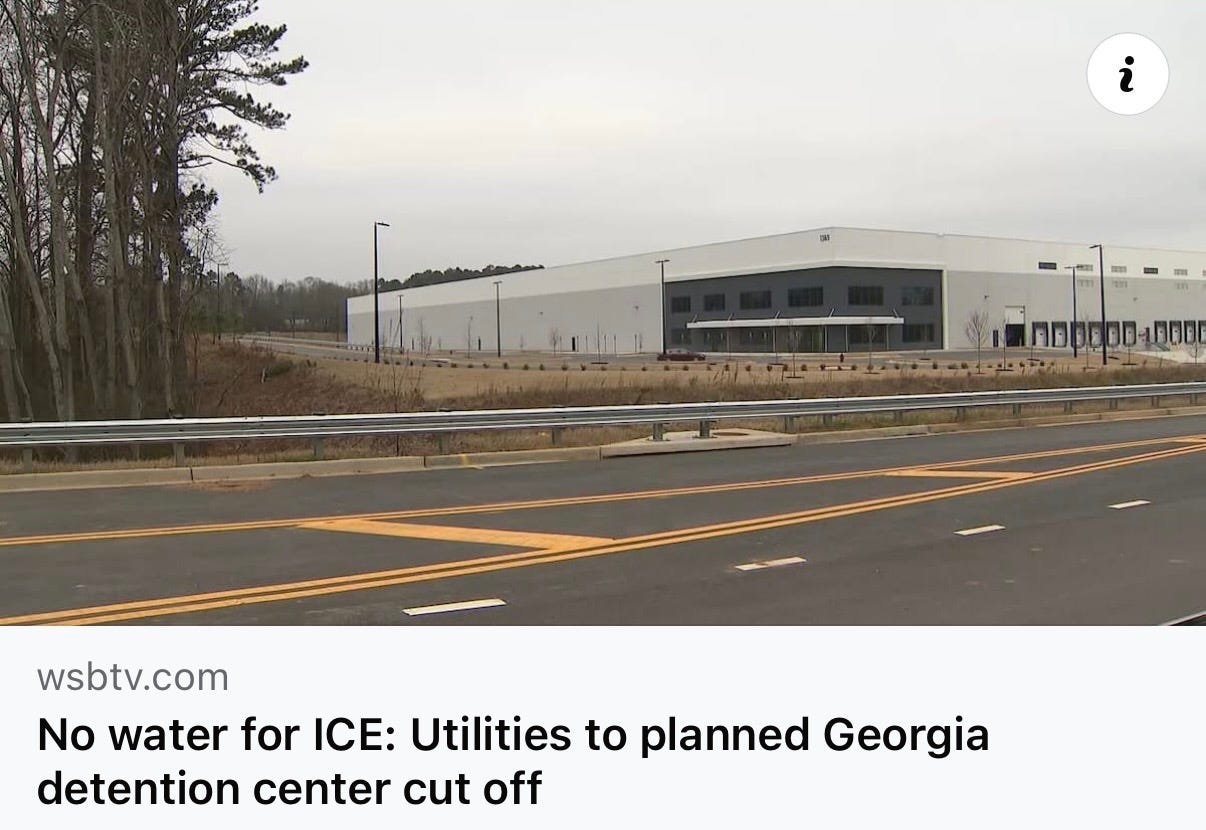
Overnight, officials in Social Circle, a town of roughly 5,000 about an hour outside Atlanta, approved a dramatic act of resistance. The city cut off water and sewer service to the site where the federal government is expected to build a massive new detention complex. According to local reporting, officials said they do not have the infrastructure to support a project of that scale and want answers about how it could proceed without overwhelming the town’s limited resources.
It was a radical move. It was also, in the eyes of many residents, overdue. Because this story is not only about the scale of what ICE wants to build. It is about how it came to light in the first place, under what residents describe as a veil of secrecy, with local leadership learning about the proposal not from the federal government, but from a Washington Post story back in December.
That detail tells you almost everything.
A Plan the Town Says It Never Asked For
For months, Social Circle leaders have been trying to get answers about a facility that could fundamentally alter the character and capacity of their town. The proposed site is a warehouse property that ICE wants to convert into what activists and local officials say could become the largest detention center of its kind in the nation. The expected detainee population: as many as 10,000 people, including children. In a town of 5,000, that is not an expansion. That is a transformation.
How do you absorb that many people into a rural town’s infrastructure? How do you handle water, sewage, traffic, emergency services, schools, hospital visits, law enforcement demands? How do you explain to residents that their town may become detention town without anyone having first asked whether they were willing to bear the cost?
Those questions remain largely unanswered. So the city answered in the only language still available to it. It shut the water off.

The Activists On The Frontline
On Nick Valencia Live, I spoke with Gareth Fenley, one of the lead activists on the front lines of the fight. Her assessment was blunt.
“The Department of Homeland Security created a secret plan,” she said. “They didn’t want the public to know anything about it, and we found out about it through a leak to the press.”
Fenley has become one of the clearest voices in this story because she understands what makes Social Circle such a revealing test case. This is not deep-blue resistance country. It is rural red Georgia. Fenley told me roughly 70 percent of local voters backed Donald Trump and vote Republican reliably. That is part of what makes this moment so politically potent.
This is not a community that rejected Trump’s immigration politics on ideological grounds from the start. This is a community now confronting what those politics look like when they arrive in concrete form; with locked gates, sewage demands, guards, detainees, traffic, and a prison economy planted directly in their backyard.
They voted for the policy in theory. Now they are recoiling from the infrastructure in practice. For years, immigration politics in America has depended on distance. The raids happen somewhere else. The detention centers are somewhere else. The suffering is processed somewhere else. The people inside the system are faceless enough that politicians can talk about them in bulk, in menace, in caricature.
That distance is what allows cruelty to function as policy. But in Social Circle, the distance collapsed. Fenley described a community wrestling not just with the physical consequences of the facility, but with the propaganda that made many residents susceptible to supporting this kind of system in the first place. Some local conservatives, she said, fear the facility because they believe Trump’s rhetoric that detention centers are filled with “the worst of the worst.” Violent predators who will threaten the town if housed nearby.
That fear is real, even if it has been built on distortion. And that is part of the tragedy here: people are not only confronting the possibility of a massive detention complex. They are confronting the lies that made such a complex politically possible.
The Human Question We Keep Avoiding
What is unfolding in Social Circle is, in some ways, bigger than a local zoning or utility fight. It is a story about class, power, and who gets sacrificed first. A small working-class town is being asked to absorb the weight of a federal detention buildout. Not a wealthy suburb. Not a gated community. Not a place with endless infrastructure and political clout. A rural town, bypassed and overlooked, now useful because it is small enough to be imposed upon.
That is a familiar pattern in America. The burden always lands downward.
And that is why this story cuts deeper than partisan hypocrisy. Yes, there is irony here in Trump voters resisting Trump’s detention expansion once it comes for them. But the more important truth is this: the people expected to shoulder the impact are not the people who designed the policy, profited from it, or will escape its consequences. They are ordinary residents. Working-class families. People worried about their homes, their property values, their roads, their hospitals, their future.
Fenley said residents fear the town could become known as “prison town,” a label that would depress property values, change the local economy, and leave people trapped in a place they can no longer sell or leave behind.
That is what makes the Social Circle story so urgent. It is not only a local rebellion. It is a window into the architecture of a larger national project, one that treats mass detention as a technical challenge to be solved by scaling up industrial space and locking more human beings inside it.
For months, city leaders have been asking for clarity. They say they have gotten very little. So now they are forcing the issue. No water. No sewer. No quiet compliance.
Social Circle is small, but the fight is not. And what they’ve done matters because it interrupts the assumption that communities must simply accept what the detention state decides for them.
The move also shows us something else, too: the moment Americans realize that a policy they once cheered from a distance looks very different when it reaches their own backyard.


